
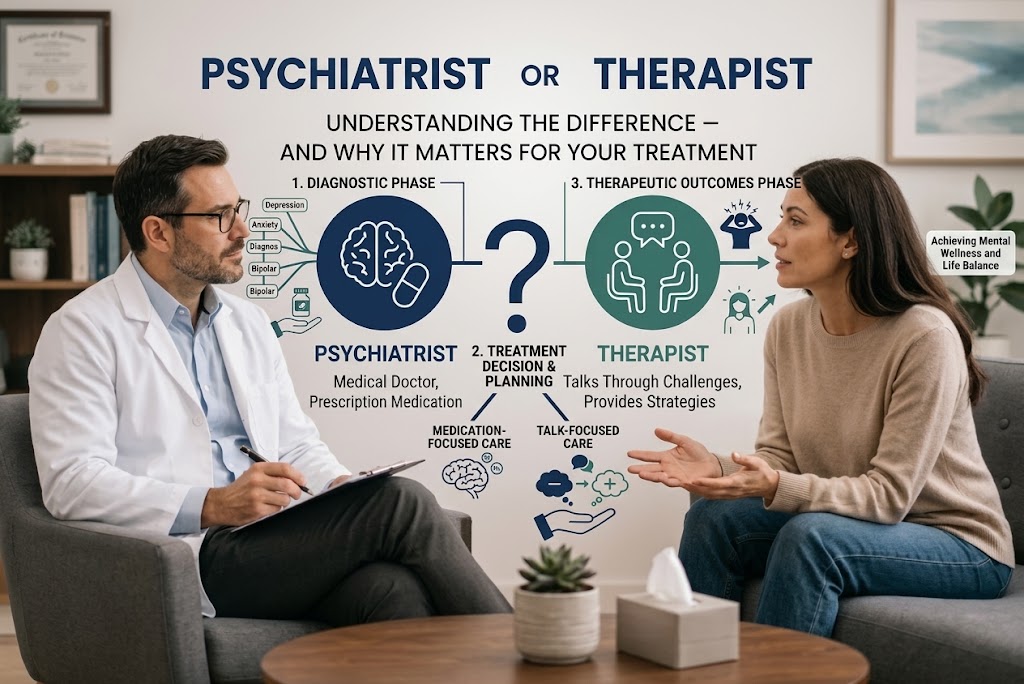
Finding the right mental health professional can feel confusing, especially when terms such as psychiatrist, therapist, psychologist, counselor, and psychiatric provider are often used together.
A common question is: What is the difference between a psychiatrist and a therapist, and how do you know which type of care may be appropriate?
The answer depends on your symptoms, treatment goals, medical needs, and the type of support you are looking for. Psychiatrists and therapists can have different education, training, and roles, and some people may benefit from working with more than one type of mental health professional.
At Mental-Heal, psychiatric care includes personalized treatment planning, medication management, supportive conversation, and practical strategies. Mental-Heal also offers in-person and telehealth appointments for patients seeking psychiatric care.
Let’s look at the differences between a psychiatrist and a therapist and how these professionals may fit into your mental health care.
What Is a Psychiatrist?
A psychiatrist is a medical doctor who specializes in mental health and psychiatric conditions.
Psychiatrists complete medical school and specialized residency training in psychiatry. Because they have medical training, psychiatrists can evaluate mental health conditions from both medical and psychiatric perspectives and can prescribe medication.
Psychiatrists may provide care for conditions such as:
- Depression
- Anxiety disorders
- ADHD
- Bipolar disorder
- PTSD
- OCD
- Mood disorders
- Other psychiatric conditions
Psychiatric treatment may include an evaluation, medication management, supportive care, lifestyle recommendations, and coordination with other healthcare professionals when appropriate.
Medication is not automatically necessary for everyone. Treatment decisions depend on an individual’s symptoms, medical history, preferences, and overall situation. NIMH notes that mental health treatment may involve psychotherapy, medication, or a combination of approaches.
What Is a Therapist?
The word therapist can refer to different licensed mental health professionals who provide psychotherapy or counseling.
Depending on their professional training and license, therapists may include psychologists, licensed clinical social workers, licensed professional counselors, marriage and family therapists, and other qualified professionals.
Psychotherapy is designed to help people understand and work through thoughts, emotions, behaviors, relationships, and life challenges. NIMH describes psychotherapy as a treatment that can help people identify and change troubling emotions, thoughts, and behaviors.
Therapy may be helpful for concerns such as:
- Anxiety and excessive worry
- Depression
- Relationship difficulties
- Grief and loss
- Stress
- Trauma
- Family concerns
- Coping with major life changes
- Emotional and behavioral challenges
Different therapists use different approaches depending on their education, training, specialty, and the needs of the person receiving care.
Psychiatrist vs. Therapist: Key Differences
The biggest difference between a psychiatrist and a therapist is generally their professional training and approach to treatment.
| Psychiatrist | Therapist |
|---|---|
| Medical doctor (MD or DO) | May have different professional backgrounds and licenses |
| Specialized training in psychiatry | Specialized training in psychotherapy/counseling depending on profession |
| Can prescribe psychiatric medications | Prescribing authority depends on professional license and state law; many therapists do not prescribe |
| Can evaluate mental health conditions from a medical perspective | Primarily focuses on psychotherapy and behavioral/emotional concerns |
| May provide medication management | Typically provides talk therapy or psychotherapy |
| May coordinate treatment with therapists and other providers | May coordinate care with psychiatrists or other healthcare providers |
The term therapist is broader than a single professional license, so it’s important to check a provider’s credentials, training, specialty, and scope of practice.
The American Psychological Association notes that psychiatrists receive medical training and can prescribe medications, while several other mental health professionals primarily provide psychotherapy.
Psychiatrist vs. Therapist: Is One Better Than the Other?
There isn’t one type of mental health professional that is appropriate for every person.
The right type of care depends on factors such as:
- Your symptoms
- Your treatment goals
- Your medical history
- How symptoms affect daily life
- Whether medication may be part of your treatment
- Whether you are primarily looking for psychotherapy
- Your personal preferences
For some people, psychotherapy may be an important part of treatment. For others, psychiatric evaluation and medication management may be appropriate. Some people receive both therapy and psychiatric care as part of a coordinated treatment plan.
NIMH explains that psychotherapy can be used alone or alongside medication and that treatment should be based on an individual’s needs and medical situation.
When Should You Consider Seeing a Psychiatrist?
You may consider talking with a psychiatrist when you are experiencing persistent mental health symptoms that are interfering with your daily life or when you want a psychiatric evaluation.
Examples may include:
- Persistent sadness or low mood
- Significant anxiety or excessive worry
- Difficulty concentrating
- Major changes in sleep or appetite
- Mood changes that interfere with daily activities
- Symptoms associated with ADHD
- Symptoms associated with bipolar disorder
- Trauma-related symptoms
- Obsessive thoughts or compulsive behaviors
- Symptoms that have not improved with previous treatment
A psychiatric evaluation can help a provider understand your symptoms, history, current concerns, and treatment needs.
If medication is considered, a psychiatrist can discuss potential treatment options and monitor your response over time.
NIMH recommends discussing mental health concerns with a healthcare professional when symptoms persist, worsen, or interfere with everyday functioning.
When Should You Consider Seeing a Therapist?
Therapy may be useful when you want professional support for emotional, behavioral, relationship, or life concerns.
You might consider therapy if you are:
- Feeling overwhelmed by stress
- Having difficulty managing emotions
- Experiencing relationship problems
- Coping with grief or a major life change
- Struggling with persistent worry
- Working through past experiences or trauma
- Trying to develop healthier coping strategies
- Looking for support with thoughts, behaviors, or patterns that are affecting your life
Psychotherapy can use different approaches depending on the person’s needs and the therapist’s training.
Can You See a Psychiatrist and a Therapist at the Same Time?
Yes. In some situations, a person may receive both psychiatric care and psychotherapy.
For example, a psychiatrist may provide psychiatric evaluation and medication management while a therapist provides regular psychotherapy.
These services can address different aspects of mental health care.
The American Psychological Association notes that people may receive care from both psychologists and psychiatrists and that collaboration between mental health professionals can be part of treatment.
If you are receiving care from multiple providers, communication and coordination can help ensure that everyone understands the overall treatment plan, when appropriate and with the necessary permissions.
Psychiatrist vs. Therapist for Anxiety
Both psychiatric care and psychotherapy may play a role in treating anxiety.
Treatment depends on the type and severity of symptoms, individual circumstances, and treatment preferences.
Psychotherapy approaches such as cognitive behavioral therapy may be used for anxiety, while medication may also be considered in some cases. NIMH states that treatment for generalized anxiety disorder typically involves psychotherapy, medication, or both.
If anxiety is affecting your sleep, work, relationships, concentration, or everyday activities, talking with a qualified mental health professional can help you understand your options.
Psychiatrist vs. Therapist for Depression
Depression treatment can also involve psychotherapy, medication, or a combination of both.
NIMH reports that treatment for depression commonly includes psychotherapy, medication, or both, with treatment decisions based on the individual’s needs and medical situation.
A mental health professional can help determine what type of evaluation or treatment may be appropriate based on your symptoms and circumstances.
What About Telepsychiatry?
Telepsychiatry allows patients to receive psychiatric services remotely through secure technology.
For people who have difficulty traveling to an office, have busy schedules, or prefer virtual appointments, telehealth may provide another way to access psychiatric care.
Mental-Heal offers both in-person and telehealth psychiatric appointments, providing patients with flexible options for accessing care.
If you are considering telepsychiatry in New Jersey, ask the provider about:
- Whether telehealth appointments are available for your location
- What technology is required
- Insurance and payment options
- How appointments are scheduled
- What services can be provided virtually
- How follow-up care is handled
How to Choose the Right Mental Health Professional
If you’re unsure whether you need a psychiatrist, therapist, psychologist, or another type of mental health professional, you don’t necessarily have to figure everything out on your own.
Start by considering what you want help with.
1. Think about your main concern
Are you primarily looking for:
- Medication evaluation or management?
- Talk therapy?
- Help understanding persistent symptoms?
- Support with relationships or life changes?
- A comprehensive psychiatric evaluation?
Your answer can help identify the type of professional to contact.
2. Consider your treatment preferences
Some people prefer psychotherapy, while others want to discuss medication options or explore a combination of approaches.
Treatment should be individualized rather than based on a one-size-fits-all approach.
3. Check the provider’s credentials
Before scheduling an appointment, review the provider’s:
- Professional license
- Education and training
- Areas of specialization
- Treatment approaches
- Telehealth availability
- Insurance participation, if applicable
4. Ask questions
It is appropriate to ask a potential provider about their experience with the concerns you want to address and what treatment approaches they typically use.
NIMH recommends asking providers about their experience, treatment approach, expected treatment duration, insurance, and cost.
Psychiatrist or Therapist: Where Should You Start?
If you’re still unsure, a conversation with a qualified healthcare or mental health professional can help you understand your options.
A primary care provider can also be a starting point and may provide an initial screening or referral to a mental health professional.
If medication management or a psychiatric evaluation is one of your concerns, a psychiatrist may be an appropriate professional to contact.
If you are primarily looking for psychotherapy and support with thoughts, emotions, behaviors, relationships, or life challenges, a qualified therapist may be appropriate.
In some cases, both types of care may be part of a person’s overall treatment plan.
Psychiatric Care in New Jersey
If you’re looking for psychiatric care in New Jersey, Mental-Heal provides personalized psychiatric services with options for both in-person and telehealth appointments.
Mental-Heal’s approach includes medication management, supportive conversation, practical strategies, and individualized treatment planning. The practice is located at 127 Union Ave, Suite 4, Middlesex, NJ 08846 and provides telehealth options as well.
Whether you’re looking for a psychiatric evaluation, ongoing medication management, or support in understanding your mental health treatment options, discussing your concerns with a qualified provider can be an important first step.
Ready to learn more about your mental health care options?
Contact Mental-Heal to schedule an in-person or telehealth appointment.
Frequently Asked Questions
1. What is the difference between a psychiatrist and a therapist?
A psychiatrist is a medical doctor specializing in mental health who can prescribe psychiatric medications. A therapist is a broader term for a qualified professional who provides psychotherapy or counseling. The exact scope of practice depends on the professional’s license and state regulations.
2. Should I see a psychiatrist or a therapist first?
It depends on your concerns and treatment goals. If you are seeking psychotherapy, a qualified therapist may be appropriate. If you want a psychiatric evaluation or are considering medication management, a psychiatrist may be appropriate. Some people receive both types of care.
3. Can a therapist prescribe medication?
Many therapists cannot prescribe medication. Prescribing authority depends on the professional’s credentials, scope of practice, and state law. Psychiatrists, as medical doctors, can prescribe psychiatric medications.
4. Can a psychiatrist provide therapy?
Yes. Psychiatrists can provide psychotherapy, although the services offered by individual psychiatrists vary. Some psychiatrists focus primarily on psychiatric evaluation and medication management, while others incorporate psychotherapy into their practice.
5. Can I see a psychiatrist and therapist at the same time?
Yes. Some people receive both psychiatric care and psychotherapy. The two professionals may address different aspects of a person’s treatment and may coordinate care when appropriate.
6. Is telepsychiatry available in New Jersey?
Telepsychiatry is a way to receive psychiatric services remotely. Availability and eligibility depend on the provider, patient location, service, and applicable requirements. Mental-Heal offers telehealth psychiatric appointments in addition to in-person care.
7. What should I ask before choosing a mental health provider?
Consider asking about the provider’s credentials, experience with your concerns, treatment approach, appointment format, expected treatment process, insurance participation, and cost.
8. What if I’m not sure what type of mental health care I need?
You can start by discussing your concerns with a qualified healthcare or mental health professional. A provider can help you understand available treatment options and determine what type of care may be appropriate for your situation.
Final Thoughts
Understanding the difference between a psychiatrist vs. therapist can make it easier to explore mental health care with confidence.
Psychiatrists are medical doctors who can provide psychiatric evaluation and prescribe medication, while therapists provide psychotherapy and counseling based on their professional training and license. In some situations, people may benefit from one type of care, while others may use a combination of psychiatric care and therapy.
Most importantly, mental health treatment should be personalized to the individual’s symptoms, needs, preferences, and medical situation.
If you’re looking for psychiatric care in New Jersey, Mental-Heal offers personalized in-person and telehealth psychiatric services to help patients explore their treatment options.